

Slovakian Projects
The Company, through its wholly owned subsidiaries SLOK and Prospech SK, owns 100% of six exploration licences, covering 161 square kilometres in Slovakia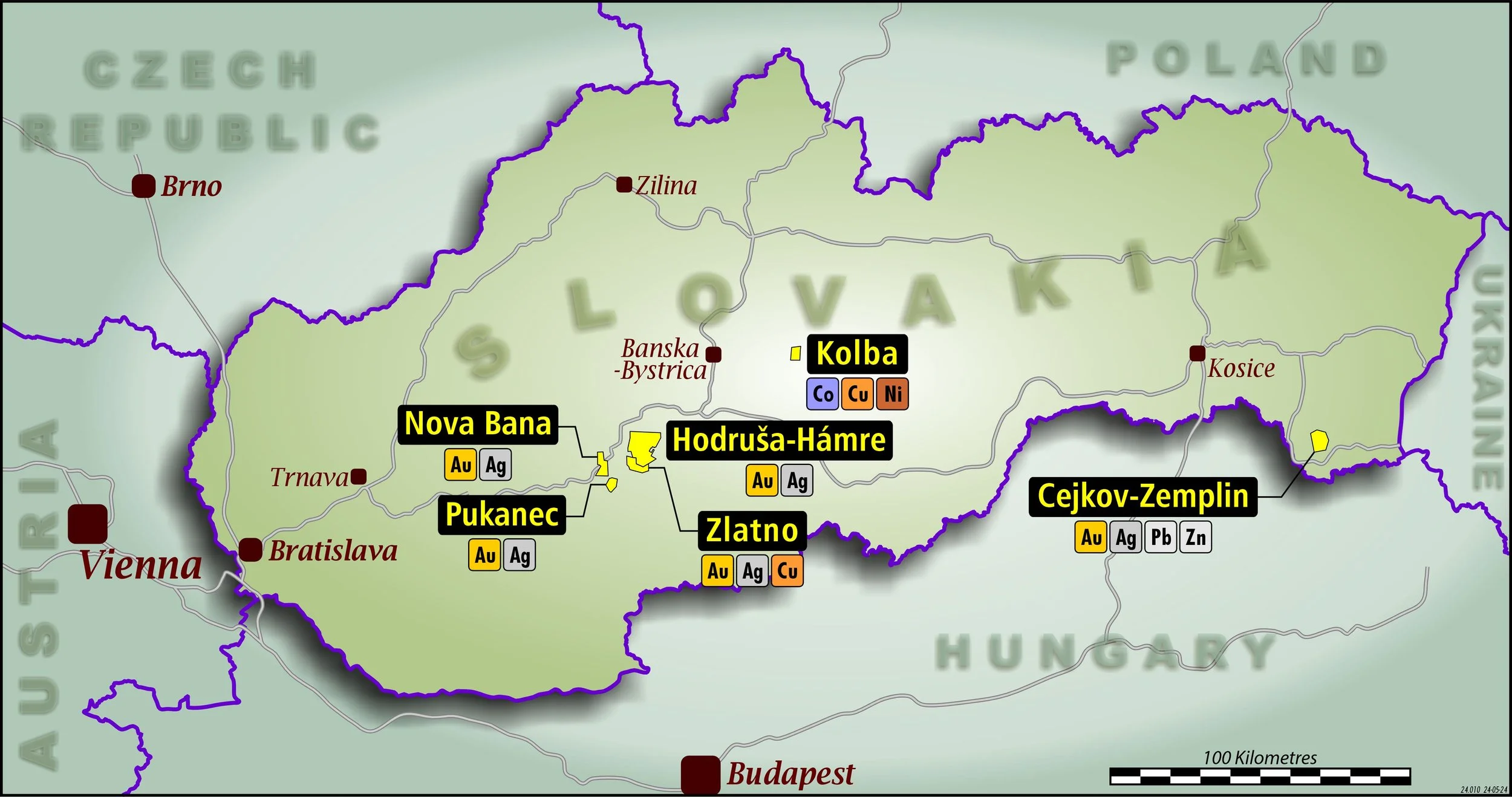
Location map of the Company’s Slovakian projects.
Licensing
- Kolba exploration licence with copper, cobalt, silver and nickel focus.
- Hodrusa-Hamre exploration licence with gold and silver focus.
- Nova Bana exploration licence with gold and silver focus.
- Pukanec exploration licence with gold and silver focus.
- Cejkov-Zemplin exploration licence with gold and silver focus.
- Zlatno exploration licence with copper andgold focus.
Kolba Exlploration Licence
The Kolba project is part of the Svatodusna – Podlipa geologic system with mineralisation consisting of copper-cobalt-nickel sulpho-arsenides. Mineralised zones of copper-cobalt-nickel-silver sulphides in primary mineralisation are typically several hundred metres long and extend for at least 150 metres from the granite footwall and the host metamorphic sequence.
A drill program of drilling is currently being permitted on this untested copper-cobalt-nickel system. High grade copper-cobalt-silver assay results from the Kolba exploration licence in two programs due to be drilled:
Results include 4.5% copper, 1,785 ppm cobalt and 796 g/t silver.
Average results are 1.9% copper, 622 ppm cobalt and 106 g/t silver.
Copper-cobalt-silver-nickel anomalous ionic leach soil geochemistry results extend exploration potential to >1.8km strike.
Hodrusa-Hamre Exploration Licence
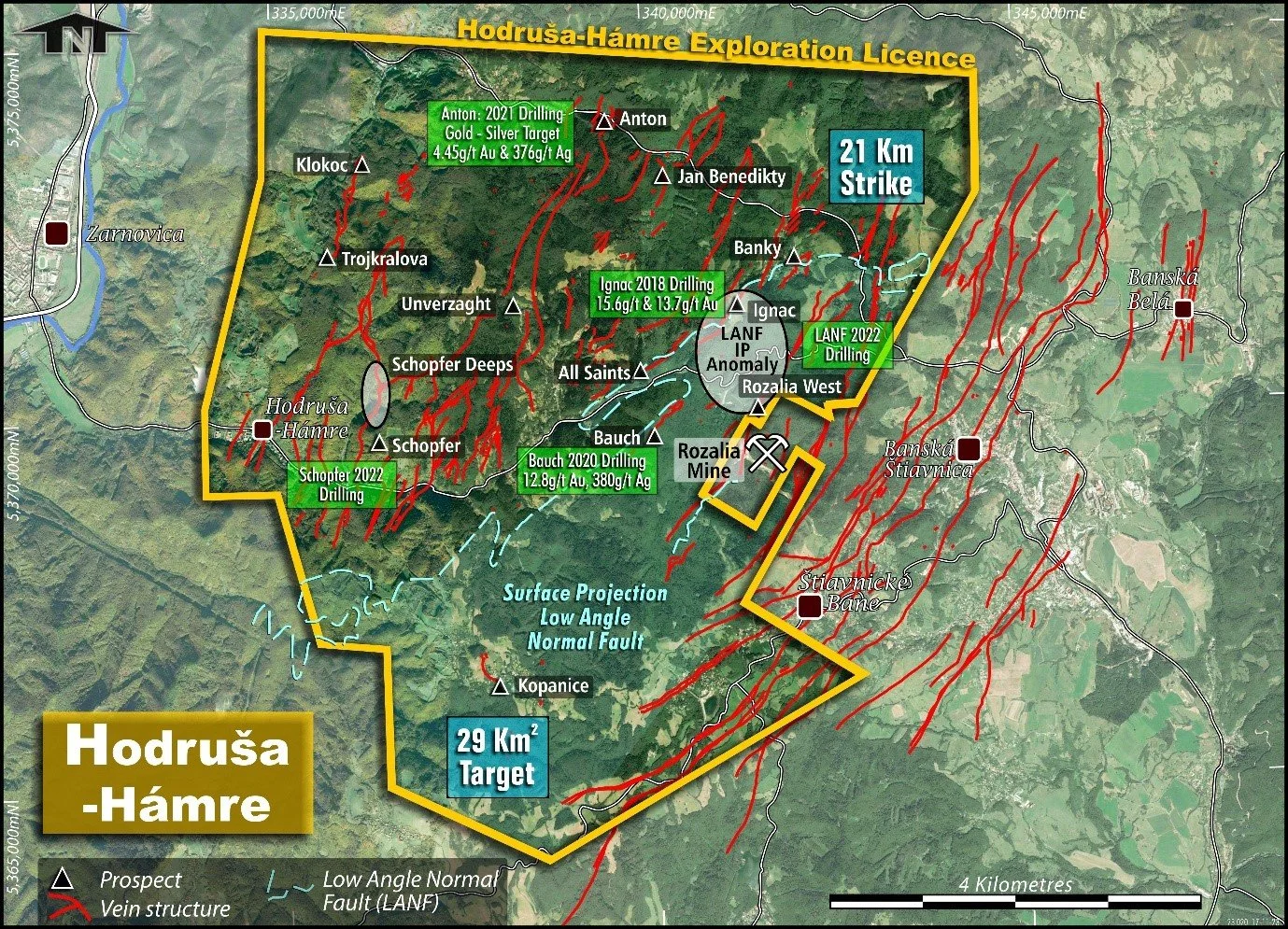
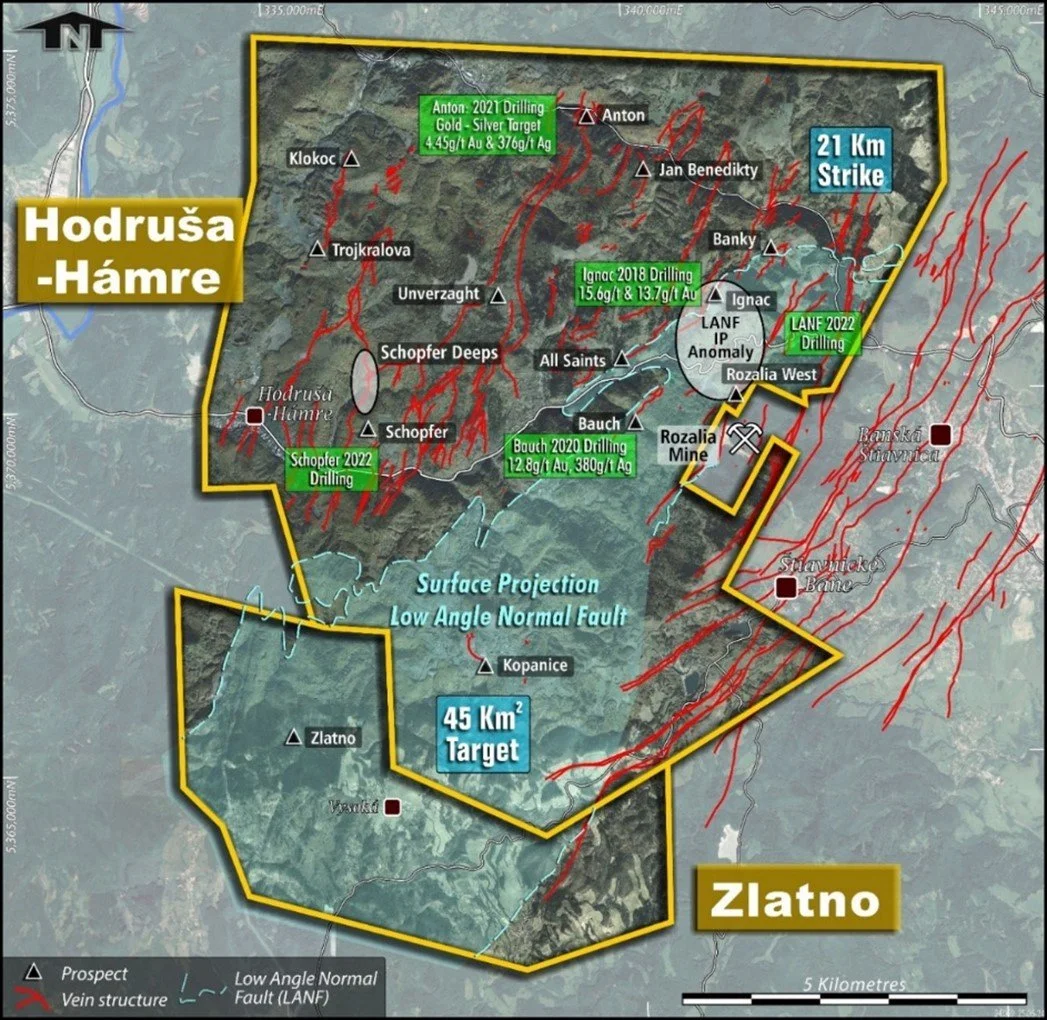
Located 200 kilometres east of Vienna, the 101.92km² Hodrusa-Hamre exploration licence covers the majority of the historic Hodrusa-Hamre/Banska Stiavnica mining district, the caldera of the Neogene Stiavnica Stratovolcano, and hosts some 120 epithermal veins with the major veins individually reaching a length of up to 6 km long.
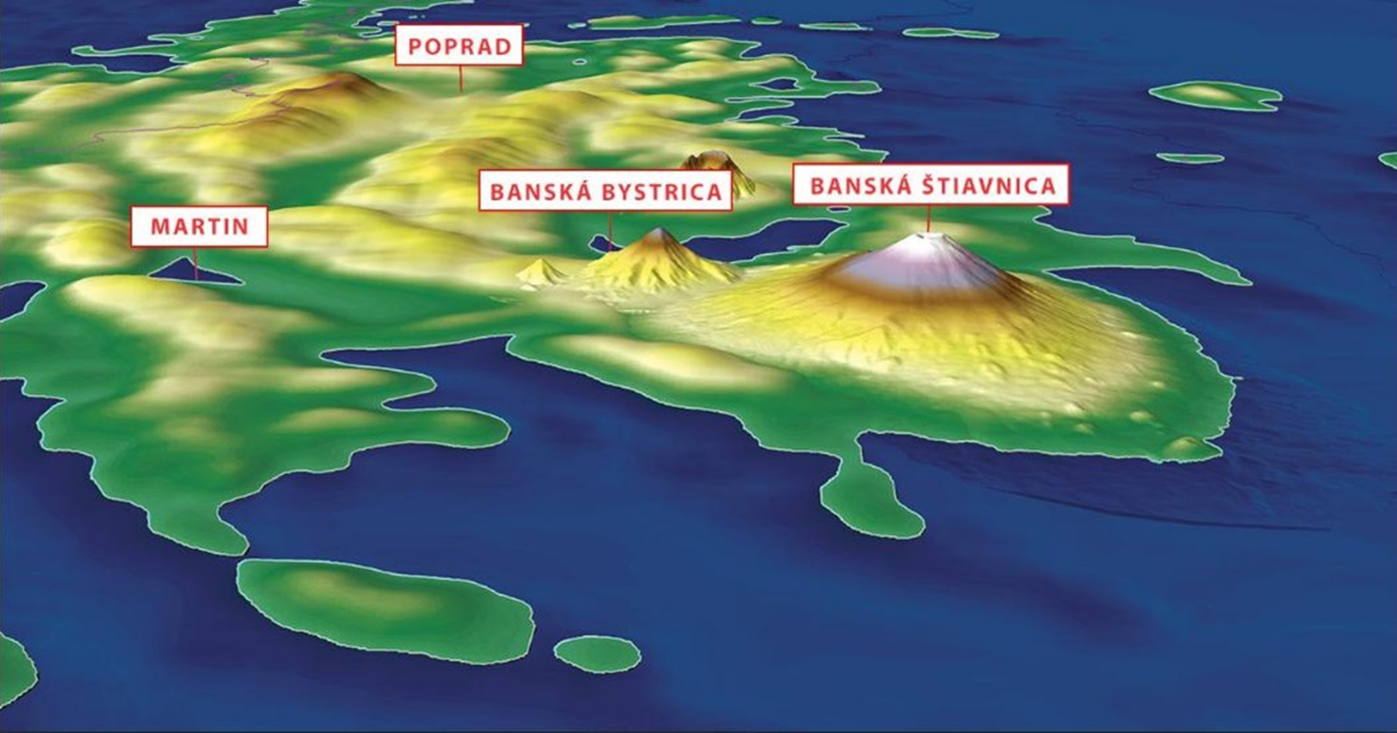
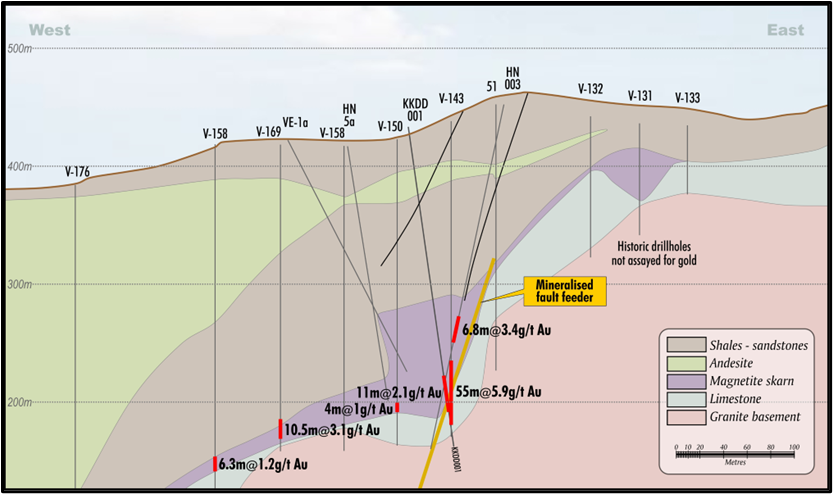
Pre Caldera imagery (shown here Banska Stiavnica largely covered by the Hodrusa Concession). In 2016/17, a significant breakthrough in the geological understanding the Hodrusa-Hamre project area was the recognition that the orebody being exploited at the nearby, and still operating, Rozalia Mine, was controlled by major Detachment Fault (locally known as a Low Angle Normal Fault or LANF). The surface trace of the LANF falls mainly within European Resources’ Hodrusa-Hamre exploration licence.
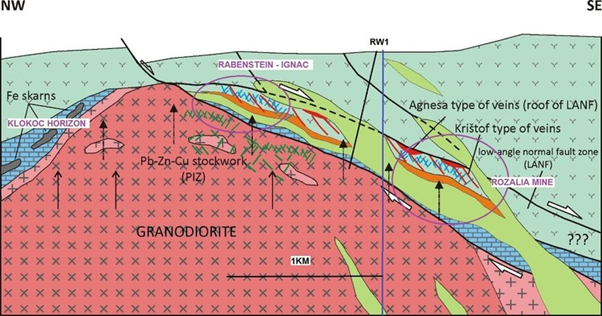
A Schematic section showing the third party, producing, Rozalia Mine and drill hole RW1 to the west, just inside European Resources’ exploration licence represented by the vertical blue line. The position of the Ignac prospect is also shown, hosted by the LANF complex which has the granodiorite in the footwall and volcano-sedimentary sequence in the hanging wall.
Nova Bana Exploration Licence
Located 15 kilometres west of Hodrusa-Hamre, the 18.14km² Nova Bana exploration licence covers an epithermal gold system with veining known to extend over an area of 3.8 kilometres by 1.6 kilometres associated with rhyolite intrusives and extrusives hosted by andesite volcanics on the flanks of the Stiavnica Stratovolcano.
Pukanec Exploration Licence
A location where mining commenced in the year 1329, Pukanec is a gold silver project with the most historical workings of any in Slovakia. The low sulphidation epithermal mineralisation is hosted in andesites. Unlike most areas in Slovakia there is a 30 to 60 metre depth of supergene enrichment which was the focus of most historic production.
Rock chips collected by European Resources in the Pukanec area include samples from the Michelka prospect where the average of all assays is 3.68 g/t gold and individual samples grade up to 9.8 g/t gold and 478 g/t silver. These samples have a clear association with manganese minerals.
CZDD001: 3.0m @ 136 g/t Ag from 59.0m and 4.5m @ 147 g/t Ag from 85.3m including 2.3m @ 240 g/t Ag from 87.5m
CZDD002: 6.0m @ 30 g/t Ag from 111.0m
CZDD003: 6.0m @ 117 g/t Ag from 94.0m Including 1.8m @ 291 g/t Ag from 97.2m
CZDD004: 4.4m @ 34 g/t Ag from 49.6m and 4.3m @ 201 g/t Ag from 92.5m including 0.5m @ 1,220 g/t Ag from 92.5m
Cejkov-Zemplin Exploration Licence
Based on archived drillhole data, there is an along strike opportunity to the northwest of Otanmaki (05) Oy’s Kontioaho operation and to the west of the Katajakangas operation (both shown as red dots in the Otanmaki (05) Oy tenement in the above map) onto the Jokikangas project.
In 2022 two campaigns of drilling were completed at Zemplin, a silver rich epithermal vein system. The discovery was made by the Slovak Government and Rio Tinto in the early 1990s but was not followed up until European Resources’ early 2021 program which produced the following results.
European Resources interprets the main silver zone trending further west of north than interpreted by previous work, which remains a continuously mineralised silver zone.
Zlatno Exploration Licence
The Zlatno copper mineralisation was discovered by the Slovak Geological Survey in the 1970s through stratigraphic drilling on a regional scale. The central zone of the Miocene Štiavnica stratovolcano hosts several occurrences of Cu-Au skarn-porphyry mineralisation.
Twenty-six deep holes were drilled between 1970 and 1980. Historically, gold was not systematically assayed, with a focus on copper due to the requirements of the pre-democratic economy before 1992 and a number of these holes intersected significant copper mineralisation:
- HDS-03: 180m @ 0.31% Cu from 781m including 36m @ 0.66% Cu from 826m
- R-06: 108m @ 0.40% Cu from 902m including 52m @ 0.63% Cu from 952m
- R-07: 184m @ 0.29% Cu from 817m including 69m @ 0.42% Cu from 921m
- R-07A: 165m @ 0.30% Cu from 805m including 45m @ 0.50% Cu from 920m
- R-09: 111m @ 0.32% Cu from 849m including 18m @ 0.50% Cu from 849m, 10m @ 1.20% Cu from 950m
- R-14: 59m @ 0.30% Cu from 927m including 9m @ 0.71% Cu from 949m
- R-20: 158m @ 0.30% Cu from 916m including 34m @ 0.50% Cu from 952m
- R-25: 164m @ 0.34% Cu from 772m including 31m @ 0.78% Cu from 777m, 20m @ 0.54% Cu from 916m
Exploration activities by European Resources
Strategy
A significant archive of historical exploration data has been acquired by the Company, which include drilling results, numerous government studies, private exploration efforts preceding Atalaya’s involvement and Atalaya’s exploration results.
European Resources has now completed first-pass 3D digitisation of more than 50 mineralised vein sets, including void modelling, to a sufficient standard to facilitate drill planning and for use in future resource estimation.
Targets identified in the Hodrusa-Hamre exploration licence include the newly recognised LANF (Low Angle Normal Fault), Ignac-Rabenstein, Bauch, Unverzagt-Alzbeta, Schopfer and Kopanice.
Mapping and Sampling
The Company has continued with geological mapping, 3D digitisation of historical mining plans and voids and rock chip sampling to facilitate drill planning. Targets selected for drilling have been ranked by a matrix of factors including proximity to the Rozalia Mine (e.g. Ignac, Bauch, Kopanice) and the vein dimensions and grades sufficient to accommodate significant exploration targets (e.g. Schopfer, Nova Bana).
More than 2,000 rock chip and channel samples have been taken by the Company to date and used as a guide to design drill plans. Assay results, from the Company’s rock chip and channel sampling of various vein systems, include the below results which highlight the potential for high grade mineralisation discovery:
- 28.00 g/t gold and 582.0 g/t silver from the Bauch prospect
- 29 samples averaged 7.80 g/t gold and 33.0 g/t silver from the Ignac prospect;
- 47.30 g/t gold and 48.0 g/t silver from the Ignac prospect;
- 58.60 g/t gold and 7,400.0 g/t silver from the Schopfer vein;
- 28.20 g/t gold and 3,210.0 g/t silver from the Schopfer vein;
- 138.00 g/t gold and 3,590.0 g/t silver from the Stefultov Stefan prospect;
- 12.50 g/t gold and 961.0 g/t silver from the Jan Benedickty prospect;
- 12.85 g/t gold and 404.0 g/t silver from the Kopanice prospect;
- 5.54 g/t gold and 8.7 g/t silver from the Jan Jozef shaft;
- 4.28 g/t gold and 272.0 g/t silver from the Rudno prospect; and
- 1.48 g/t gold and 60.4 g/t silver from the Banska Bela prospect.
Mining and exploration history
Historically, the metal most mined was silver, which formed the main coinage of the Austro-Hungarian Empire. More recently, during the communist era, the targets for mining were principally industrial base metals such as copper, lead and zinc. As a result, much of Slovakia, including the Company’s exploration licence areas, has not been subject to modern exploration methodology for gold and silver.
Slovakia has a known mining history dating back to Celtic times and earlier. Tools used by prehistoric miners at Spania Dolina, near Banska Bystrica are dated as early as 2,000-1,700 BC. Major production of metals (primarily copper and silver) occurred during the medieval period. The second oldest mining institute in the world is located at Banska Stiavnica (nearby to the Company’s Hodrusa-Hamre exploration licence area) and the local population is proud of their mining heritage, holding a three day mining festival every year. The mint at nearby Kremnica has operated for over six hundred years and continues to operate today.
The Hodrusa Hamre Project surrounds the third party Rozalia Mine, which is an underground mine that produces very high-grade gravity/flotation gold concentrate. The concentrate is further refined by a smelter in Belgium.
Base metals were the focus of mining during the Communist era – particularly from the Government owned Rudne Bane mining lease, which is adjacent to the Company’s Hodrusa-Hamre exploration licence. Ore comminution was coarse and precious metal recovery was poor. No precious metal assaying was done as only base metals rich veins were targeted for exploitation. Numerous, potentially gold and silver bearing hanging wall and footwall veins, close to actively mined areas, were ignored if payable base metal mineralisation was not observed.